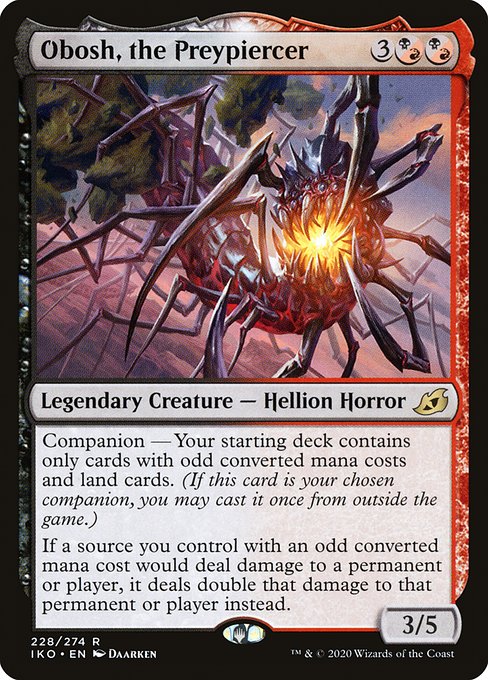
First printed in Ikoria: Lair of Behemoths (2020)
All 9 prints
Log in to choose your favorite print: the site shows it in your decks, in the search and in the simulator.
-
 Multiverse Legends (MUL) #119, 2023
-
 Multiverse Legends (MUL) #184, 2023
-
 Multiverse Legends (MUL) #184z, 2023
-
 Multiverse Legends (MUL) #54, 2023
-
 Magic Online Promos (PRM) #80863, 2020 (digital)
-
 Ikoria: Lair of Behemoths (IKO) #228, 2020
-
 Ikoria: Lair of Behemoths (IKO) #357, 2020
-
 Ikoria: Lair of Behemoths Promos (PIKO) #228p, 2020
-
 Ikoria: Lair of Behemoths Promos (PIKO) #228s, 2020

Legendary Creature — Hellion Horror
Companion — Your starting deck contains only cards with odd mana values and land cards. (If this card is your chosen companion, you may put it into your hand from outside the game for  as a sorcery.)
If a source you control with an odd mana value would deal damage to a permanent or player, it deals double that damage to that permanent or player instead.
3/5
- Illustrated by
- Daarken
Legality
- Legal in
- Pioneer, Modern, Legacy, Vintage, Historic, Timeless, Penny Dreadful, Gladiator, Commander, Duel Commander, Oathbreaker, Brawl, Competitive Brawl
- Not legal in
- Standard, Pauper, Future Standard, Alchemy, Premodern, Old School 93/94, Pauper Commander, PreDH, Tiny Leaders, Standard Brawl
Rulings (19)
- For spells with
 in their mana costs, use the value chosen for X to determine the spell's mana value. If a permanent or card in any other zone has in its mana cost, X is considered to be 0.
- You may have one companion in the Commander variant. Your deck, including your commander, must meet its companion requirement. Your companion is not one of your one hundred cards.
- If multiple replacement or prevention effects try to modify damage that would be dealt to a permanent or player, the player or the controller of the permanent chooses the order in which they apply.
- The requirements of the companion ability apply only to your starting deck. They do not apply to your sideboard.
- If a creature with trample you control would deal combat damage to a blocking creature while you control Obosh, you must assign its unmodified damage. For example, a 3/3 creature with trample blocked by a 2/2 creature can have 1 damage assigned to the defending player. It will then deal 4 damage to the blocking creature and 2 damage to the defending player.
- If more than one player wishes to reveal a companion, the starting player does so first, and players proceed in turn order. Once a player has chosen not to reveal a companion, that player can't change their mind.
- If a card in a player's library has in its mana cost, X is considered to be 0.
- If an effect such as that of Ravenous Gigantotherium asks you to divide damage among targets, you must divide the unmodified damage before doubling it.
- If you reveal a companion outside the game, for as long as it remains there, you may pay any time you could cast a sorcery (that is, you have priority during your main phase and the stack is empty). Once you do, you put it into your hand and behaves like any other card you've brought into the game. For example, if it's discard, countered, or destroyed, it's put into your graveyard, remaining in the game. This is a change from previous rules.
- The companion ability has no effect if the card is in your starting deck and creates no restriction on putting a card with a companion ability into your starting deck. For example, Zirda may be in your starting deck even if your other permanent cards don't all have activated abilities.
- Before shuffling your deck to become your library, you may reveal one card from outside the game to be your companion if your starting deck meets the requirements of the companion ability. You can't reveal more than one. It remains revealed outside the game as the game begins.
- The companion's other abilities apply only if the creature is on the battlefield. They have no effect while the companion is outside the game.
- Your companion begins the game outside the game. In tournament play, this means your sideboard. In casual play, it's simply a card you own that's not in your starting deck.
- Paying to put your companion into your hand is a special action. It doesn't use the stack and players can't respond to it. Once you take this action, you may cast that card if it's legal to do so before any other player can take actions.
- Wizards of the Coast has issued functional errata for the Companion mechanic. Instead of casting companions from outside the game: Once per game, any time you could cast a sorcery (during your main phase when the stack is empty), you can pay to put your companion from your sideboard into your hand. This is a special action, not an activated ability. It happens immediately and can’t be responded to. It can’t be countered or stopped by cards like Phyrexian Revoker. For more information please see https://magic.wizards.com/en/articles/archive/news/june-1-2020-banned-and-restricted-announcement
- Once you put your companion into your hand, it behaves like any other card you’ve brought into the game. For example, if it’s countered or destroyed, it’s put into your graveyard, remaining in the game.
- Paying to put your companion into your hand is a special action. It doesn't use the stack and players can't respond to it. Once you take this action, you may cast that card if it's legal to do so before any other player can take actions.
- If you reveal a companion outside the game, for as long as it remains there, you may pay any time you could cast a sorcery (that is, you have priority during your main phase and the stack is empty). Once you do, you put it into your hand and behaves like any other card you've brought into the game. For example, if it's discarded, countered, or destroyed, it's put into your graveyard, remaining in the game. This is a change from previous rules.
- The damage is dealt by the same source as the original source of damage. The doubled damage isn't dealt by Obosh unless it was the original source of damage.
Prices
MTGO price: 0.006 TIX, the cheapest non-foil print (average sell price on GoatBots, 1 Nov 2026).
In Limited on MTG Arena
Win rates in Arena drafts and sealed, retrieved from 17Lands (CC BY 4.0).
| Set | GIH WR | vs set | IWD | Games |
|---|---|---|---|---|
| March of the Machine (MOM), Premier Draft | 53.7% | -1.1 | +1.4 | 8443 |
| March of the Machine (MOM), Sealed | 60.1% | +4.7 | +7.1 | 707 |
- GIH WR
- win rate of the games in which the card was in the opening hand or drawn
- vs set
- points above or below the average win rate of all decks in the set
- IWD
- improvement when drawn: GIH WR minus the win rate when the card stayed in the library
- Games
- games in which the card was seen
Combos
6 combos, the most popular first:
- Each opponent with an even life total loses the game, Near-infinite damage: Glacial Chasm + Heartless Hidetsugu + Obosh, the Preypiercer
- Each opponent with an even life total loses the game, Near-infinite damage: Heartless Hidetsugu + Obosh, the Preypiercer + Platinum Angel
- Each opponent with an even life total loses the game, Near-infinite damage: Heartless Hidetsugu + Obosh, the Preypiercer + Platinum Emperion
- Infinite colored mana, Infinite damage…: Crystalline Crawler + Hanabi Blast + Obosh, the Preypiercer + Oskar, Rubbish Reclaimer + Vigor
- Infinite colored mana, Infinite damage…: Conspiracy Theorist + Crystalline Crawler + Hanabi Blast + Obosh, the Preypiercer + Vigor
- Infinite colored mana, Infinite damage…: Bösium Strip + Crystalline Crawler + Hanabi Blast + Obosh, the Preypiercer + Vigor